This project was made in IOED Lab, NTU
OPTIC 2025
I had the opportunity to present my research at the Optics & Photonics Taiwan International Conference (OPTIC) 2025, held in December 2025. It was a great experience to share our work on heterojunction phototransistors with researchers and engineers from across the optoelectronics community, and to engage with the latest advances in photonics and semiconductor device research.
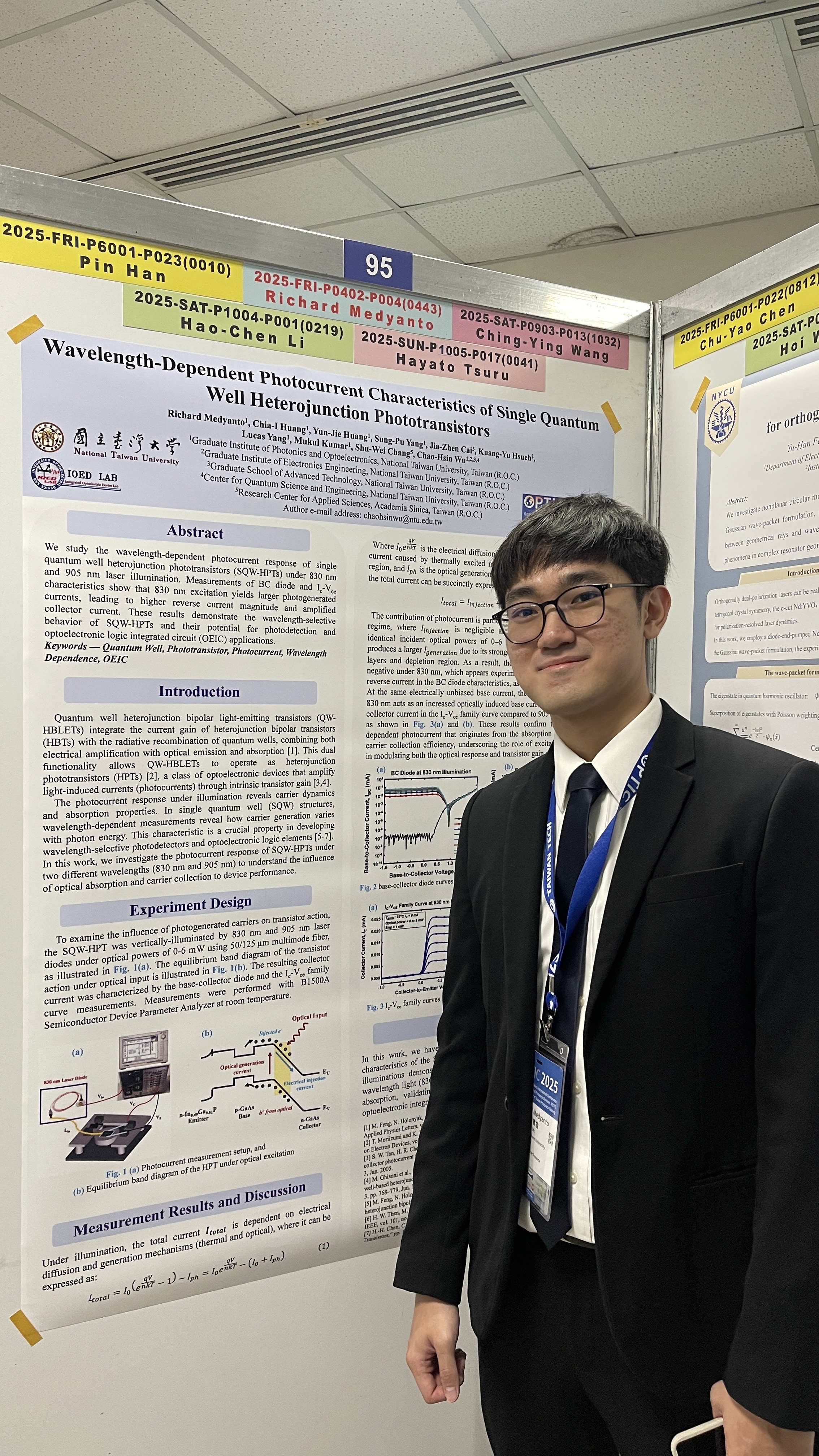
Research
Our research investigates the wavelength-dependent photocurrent response of single quantum well heterojunction phototransistors (SQW-HPTs). They are devices that combine the current gain of heterojunction bipolar transistors (HBTs) with the light-absorption properties of quantum wells. By illuminating the device with 830 nm and 905 nm laser diodes, we studied how different photon energies affect carrier generation and, in turn, transistor output.
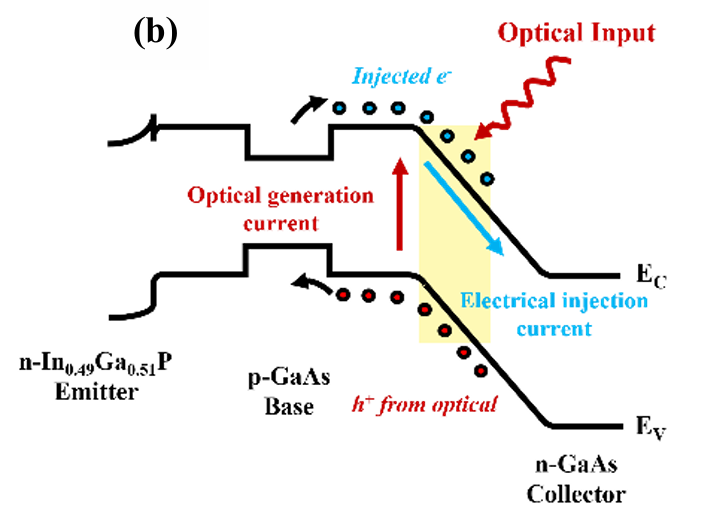
The key idea is that under illumination, photogenerated carriers in the depletion region act as an optically induced base current, which gets amplified by the transistor’s intrinsic gain. The band diagram below illustrates how the transistor operates under optical input. Photons are absorbed near the quantum well and depletion region, sweeping carriers and producing a photocurrent.
Because 830 nm light has a shorter wavelength (higher photon energy), it is more strongly absorbed in the GaAs-based active layers compared to 905 nm. This leads to a larger photogenerated current, which is clearly visible as a higher reverse-current magnitude in the base-collector (BC) diode characteristics and a larger collector current in the I_c–V_ce family curves.
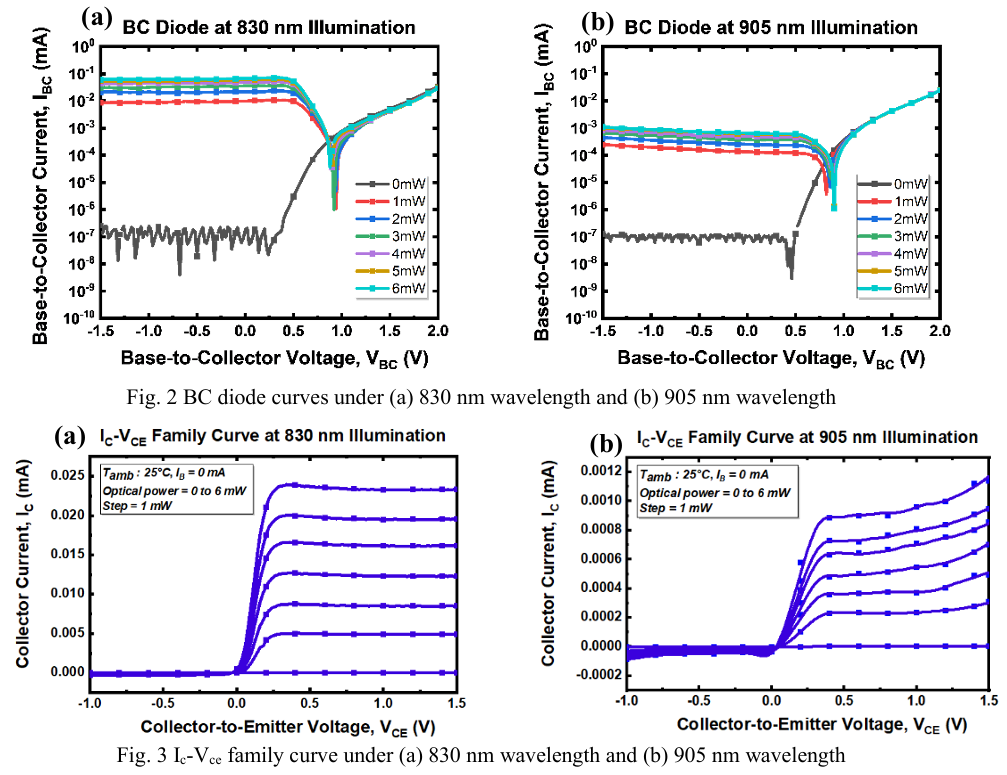
These results confirm the wavelength-selective behavior of SQW-HPTs, which makes SQW-HPTs promising candidates for wavelength-selective photodetectors and optoelectronic integrated circuit (OEIC) applications.